12. Malaysia @ Borneo - Kuching

Then we arrived Kuching on Borneo, but first we flew from Yogyakarta on Java to Johor on mainland Malaysia and then ....


from Johor on mainland Malaysia to Kuching on Malaysian side of Borneo.


Borneo is the third largest island in the world. The island is divided by three countries. Malaysia and Brunei in the north covers 26 % and 1%. Indonesia to the south covers approximately 73 %. 

Borneo's population consists mostly of Malays, Chinese and Iban.

The Malaysian part is devided in two. Sarawak to the west and Sabah to the east. Sarawak meaning "The land of Hornbils" is the biggest of the two regions.

Natural resources, specially the industry of petroleum and palm oil, work with timber and tourism are the largest industries of Malaysian Borneo. 

We came to Borneo in rain, but


we checked in to our "Grand Suprime" hotel. It looked like something from the Eastern part of Europe. But it had lifts and our room was really really good. We had a good strong shower with hot water. The room was clean and we had a nice view from our window. Last we had a water boiler so we could make coffee and tea and boil noodles for dinner. Good and cheap.


Most hotels have these signs on the front doors. Durian is a fruit that is very typically here in Asia. It is very smelly and that is the reason for the hotels not to want it inside.


This view  together with the next couple of pictures is taken from our hotel room in Kuching.


Kuching is the capital and the most populous city in the state of Sarawak in Malaysia. The city is situated on the Sarawak River and has a population of about 350.000 people.


Kuching has a tropical rainforest climate, which means that the temperature is moderately hot and it is very humid, with the heat index often reaching 42 degrees. Kuching is also the wettest populated area in Malaysia with an average of 247 rainy days per year.


This picture we took an evening we walked around in Kuching. Its just a random building, Markus who took the picture just thought it was a nice building.

Kuching means cat in Malay and there were many cats in the city. Some alive and some as statues around the city.


These cats were just outside one of the two city halls in Kuching.


These cats were in the middle of a big roundabout in the middle of the city.


Here is a white cat just in front of the Chinese entrance to the Chinese street/part of the city.


There is a cat museum in Kuching and we went to visit it.


The cat museum was voted to be housed here in the northern city hall in year 1993. And believe it or not but it had quite many visitors. Some locals and some tourists like us.


We read in the museum that most people from Malaysia thinks that cats bring good luck and it is very important to have cats around.


The cat museum features more than 2000 feline related items.


It is more than just a museum. The place is also a research center, that focuses on the history and various beliefs surrounding cats.


Among the most impressive displays are a mummified Egyptian cat dating back to 3500 BC. But we were not aloud to take pictures of it.


They also had a little Garfield collection.


We read that it is believed that the cat museum is the only one of its kind in the world and that it is a must visit attraction for cat lovers. So of course we visited it. :)


The view from the city hall was really nice and the best thing was that we got a ride from a nice British gentleman back to the city center.


Kuching Mosque with the big gilded cupolas is the largest religious building in Sarawak.

Kuching plays an important role in the political and economic welfare of the population of Sarawak.


This is the Sarawak State Legislative Assembly, completed in year 2009. It is the meeting place where state assemblymen from all over Sarawak will meet and preside over debates and passing laws.


The orchid garden in Kuching has a collection of 75000 orchids, growing in open and shaded areas resembling their natural habitats.


It was serious warm that day and we both got a little sunburned even that we used sunscreen. :( But the orchids were beautiful.
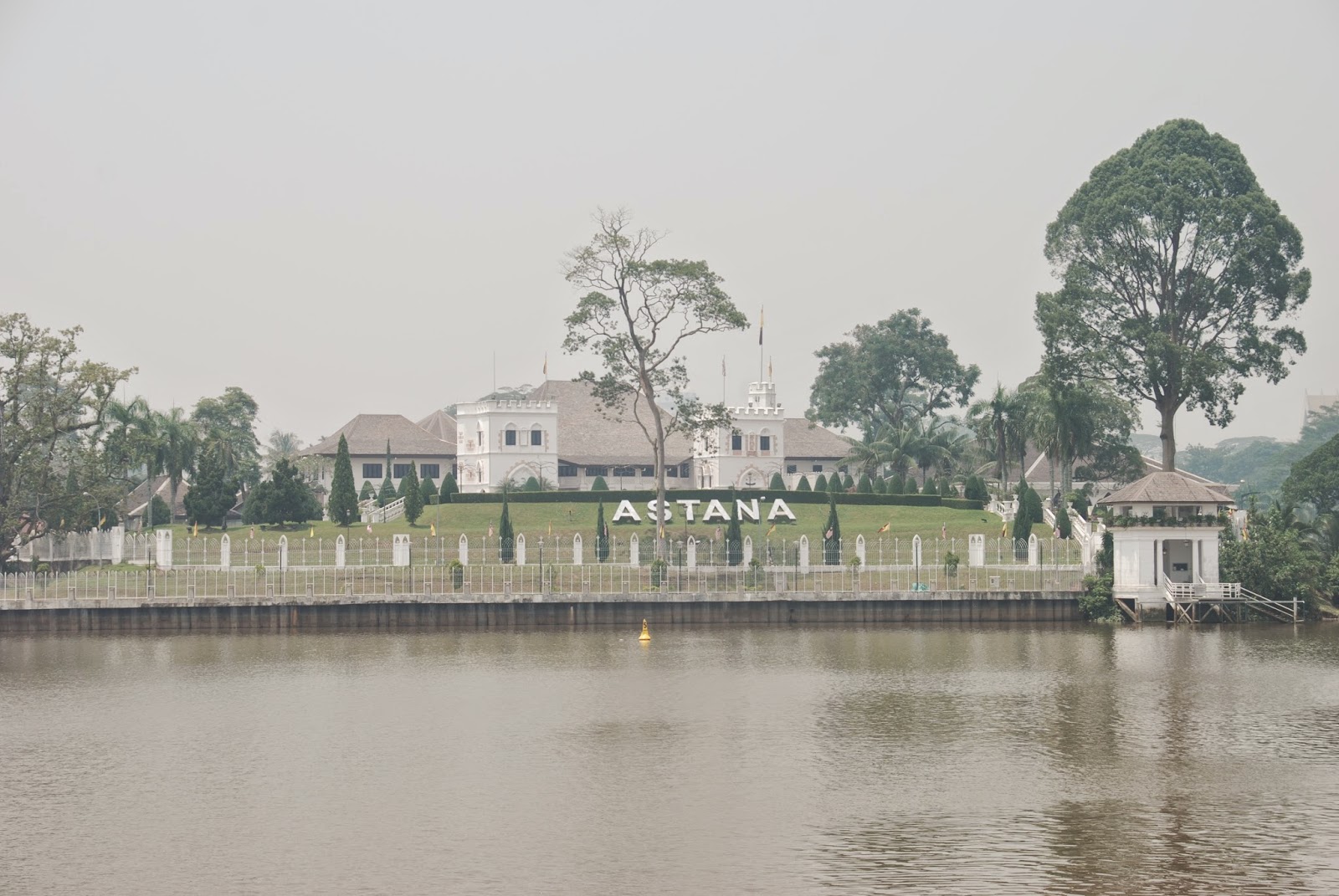

This is the Astana, built in year 1870, which is the official residence of the Yang di-Pertua Negeri (Governor) of Sarawak


This is Markus and fort Margherita built in year 1879 by Charles Brooke. The fort is named after his wife.


The State Legislative Assembly together with the orchid garden, the Istana and the fort Magherita were on one side of the river, while most of Kuching city including our hotel was on the other side.


This is a picture of one of the water-taxis that will take you across the river whenever you need to cross.

11. Indonesia @ Java - Yogyakarta

On our way to Yogyakarta on Java in Indonesia, we had to change flight on Bali. Therefor we had a night on Bali before we reached Java.


Yogyakarta is a city and the capital of Yogyakarta Special Region in Java, Indonesia.


It is renowned as a center of education, classical Javanese fine art and culture such as batik, ballet, drama, music, poetry and puppet shows.


Yogyakarta has a population of over two million people in the metropolitan area.


There were plenty of small bikes and horses if we wanted a cheap ride.


Also local markets were everywhere.


Yogyakarta was the Indonesian capital during the Indonesian National Revolution from year 1945 to 1949. One of the districts was the capital of the Mataram Sultanate between year 1575 and 1640 and the head of the area has still the title of sultan.

We arrived in Yogyakarta in the afternoon. Markus has been to Yogyakarta before so he could easily guide us to the train and to the center of the city, where we had lunch and found a cheap guesthouse.


Then we went out to buy a ticket to see the main attraction of Yogyakarta for the next day.


We bought a full day ticket which gave us transport to three temples in the area.

We got picked up the following night/morning at 03.45. We were going to see the sunrise over the Borobudur temple.


We thought it would be amazing like other sunrises we have seen before, but it was a failure.


It was overclouded and misty and we were way too far away for good pictures. The good thing was, that we were only us and another couple on the tour. The other couple came from Holland and it turned out, that they were really nice and we had a lot of fun with them.

The Borobudur temple is a Mahayana Buddhist temple dating from the 8th and 9th centuries.


The monument consist of six square platforms topped by three circular platforms and is decorated with 2672 narrative relief panels and 504 Buddha statues.


A main dome is located at the center of the top platform and is surrounded by 72 Buddha statues each of which is sealed inside a perforated stupa.


It is the world's largest Buddhist temple with the largest and most complete ensemble of Buddhist reliefs in the world as well as one of the greatest Buddhist monuments in the world.


Evidence suggest Borobudur was constructed in the 9th century and abandoned following the 14th century decline if Hindu kingdoms in Java and the Javanese conversion to Islam.


Worldwide knowledge of its existence was sparked in 1814 by Sir Thomas Stamford Raffles, then the British ruler of Java, who was advised of its location by native Indonesians.


Borobudur has since been preserved through several restorations.


The largest restoration project was undertaken between 1975 and 1982 by the Indonesian government and UNESCO, following which the monument was listed as a UNESCO World Heritage Site.

After our visit to Borobudur we visited a the smaller Buddhist temple, Candi Mendut.


The temple is 26,4 meters tall and located in Mendut village about 3 kilometers east from Borobudur.


An old sacred Waringin also known as Banyan tree.

It is said that there is a religious relationship between the temples, although the exact ritual is unknown.


The main room has three carved large stone statues of Buddha.

Our last temple visit that day was the 9th century Hindu temple Candi Prambanan.


It is characterized by its tall and pointed architecture with a 47 meter high towering central building inside a large complex of individual temples.


The temple complex is located 17 kilometers outside Yogyakarta and is dedicated to the Trimurti, the expression of God as the Creator (Brahma), the Preserver (Vishnu) and the Destroyer (Shiva).


The temple is on the list of UNESCO World Heritage Sites and is the largest Hindu temple in Indonesia and one of the biggest in Southeast Asia.

After our last visit we went back to our little cheap hotel but first agreed with the couple from Holland to meet them later.

After a nice dinner we went back to our hotel and slept like babies all night long.

The day after we went with the couple from Holland to see the Sultan's Palace or Karaton Ngayogyakarta Hadiningrat and Taman Sari Water Castle. Altough we had to postpone our visit to the Sultan's palace for the next day because Markus wasn't allowed to go in. The reason was his sleeveless t-shirt, not his condition.

The Palace was built from 1755 to 1756. Today the palace is still the principal residence of the sultan while also the royal court has its seat here.


Today it is the cultural and the political heart of Yogyakarta and the area surrounding it, but it is open to the public in the mornings.


It is always the women who has to cover their body before entering some place religious or royal, but not here. It was Markus who was the "problem".


In the palace we saw a series of  luxurious halls and spacious courtyards and pavilions.


We went to see a concert in the palace.


Not all the players looked like they actually enjoyed working there.


We also saw some Javanese dance.


The dancers were very beautiful and


graceful.


One of the many dragons decorating the palace.


A part of the palace is a big museum and among many other things of different levels of interest we saw this old chair.


This is me outside the center of the palace, which is the reception hall, Bangsal Kencana or Golden Pavilion. The floor is made out of marble and the columns are carved teak decorated with gold.


The water calstle is a complex, that used to be a former royal garden and bathing palace for the Sultanate of Yogyakarta.


It is said, that the sultan sometimes had up to 100 virgins in his private pools.


He also had a tower from where he could pick the girl he wanted the most... :) It's good to be the sultan.

The day after we flew to Johor Bahru in Malaysia and from there we flew to Kuching in Borneo. On the way out of Indonesia they stopped us in the passport control. The officers told us we had overstayed our visa, which after long discussion cost us 30 dollars each and we did not even do it by purpose.

The 30 days visa turned out to be 29 days visa as they count the day of entrance already one day used.