We got picked up in Ubud by a good minivan. This shuttle bus took us and 6 other tourists the ca. 2 hours to Padangbai, which is the harbour town. There we checked in and waited for our boat. The check in was in a restaurant, where two guys sat by a table. It was a total chaos, but we got our ticket and fought our way back to our luggage. Then we waited together with many others... We waited what seemed like about 500 people on the little pier in not a lot of shade for our boat. The fast boat that should take us to the biggest of the Gili Islands, Gili Travangan. Also on the pier it was total chaos and once in a while huge trolleys full of luggage carried by at least 3 men fought there way through us. Everybody was screaming and the vendors were there as well trying to sell everything, but especially food and drinks. After about 1½ hours our boat came and we got on it and found some seats. It was an ok boat and it took us only about 1½ hours to reach our destination. We were so happy. Then Carina sat with the luggage while Markus found us a little guesthouse and we moved in.

The Gili Islands are in a local Lombok guide described as "three perfect coral islands".

The three Gili islands are; Gili Trawangan, Gili Meno and Gili Air. The islands are all fringed with white sand beaches and swaying palm trees.

They are situated in the sparkling Indian Ocean, just off the north-west coast of Lombok.
The word "Gili" means "small island". The guide further explains, that every year The Gilis attract tens of thousands of visitors from around the world. Visitors, including us, go to the Gilis for their pristine waters with white beaches,

great diving and snorkeling opportunities, laid back charm during the day and a nightlife that offers to party all night long.

The waters around the islands are home to an abundant variety of corals, aquatic life and thousands of species of tropical fish. But unfortunately people have been dynamite fishing so the reef is more or less dead.
Gili Trawangan is the most developed of the three island with the greatest range of facilities and activities. While the two other islands has a more laid back style.

This is an example of the means of transportation on the Gili islands. No motorised transportation is found on the islands.
We caught up with Christina, Ryan and Anna again. The same people as we met in Bali and celebrated Markus' birthday. We were all quite in the mood of relaxing, so that was how we spend most days.
Laying on the beach and drank fruit juice and beer all day. In the evening we went out to eat on one of the many restaurants and

after that we went for good cheap drinks on one of the many bars.
Not a bad way of spending the days.
The beach were a bit disappointing because it was not as sandy as we hoped for, but had a lot of different size corals we needed to walk on to get in the water. That hurt, but the water was lovely. Warm and clear.
One of the days at Gili Travangan we decided to rent a private boat for the 5 of us and go for a 5 hour snorkeling trip.
That became an adventure.

Carina got really seasick. Ryan had taken a seasick tablet to avoid seasickness, but instead were so drowsy that he slept most of the trip. Anna were seasick, but not as bad as Carina, while Christina just felt bad.
But Markus felt good all the way.

Markus wearing the GoPro. He was one taking pictures all the day.

Carina before she got seasick.
The first stop, we were all in the water and snorkeled around. It was pretty with all the fish, but there were not much living coral reef.

At the second stop, Christina was the first to jump in the water and the first to dislike all the small stingers in the water. They stung us. After being in the water for a very short time we went back to the boat. We saw a turtle, but it was really far away and I guess the guide was the only one excited about that.
At the third stop, Markus was the only one snorkeling.

Markus snorkeling

We were close to the beach and the water was beautiful clear.
The girls went to the beach to use the bathrooms and Ryan was sleeping/relaxing in the boat.
Now it was time for lunch, which we had on the island Gili Air.
We also walked a bit around on the island.
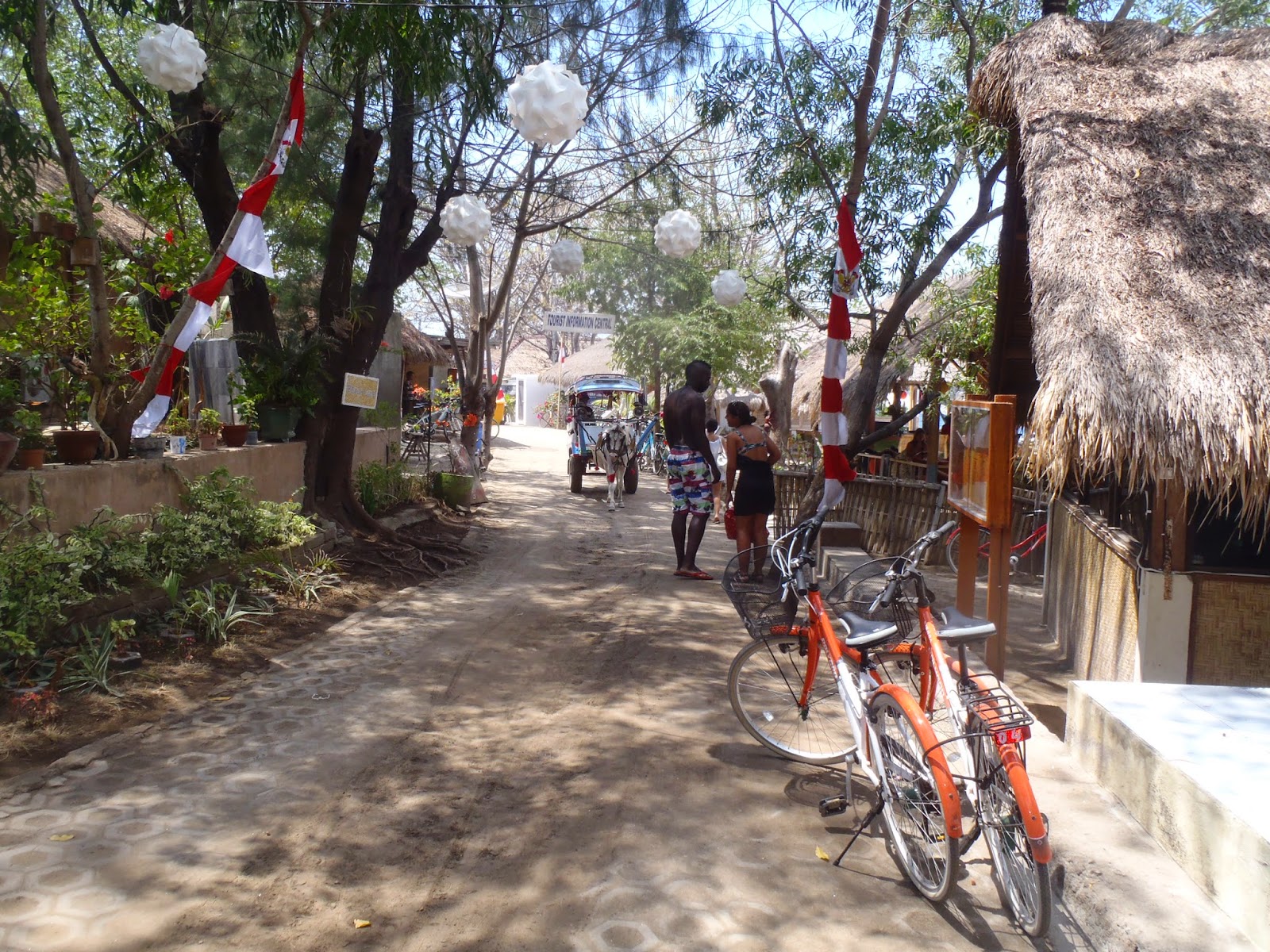
It was very pleasant.

Bikes are used on the island. Many off them have wide tires.

A nice looking restaurant and Ryan posing behind the face.

Now in the boat again, we all felt good.

In the front Christina and Anna, in the back Carina and Ryan.
We only had about half an hour before reaching our Gili Travangan.

Carina together with Ryan
The tour back started really nice and the sea was calm and flat.

But the it became very rough and on the way back we all got so wet by the big waves splashing into our boat.
We were soaking wet when we reached our island, but we were happy.
Carina, Ryan and Markus want to eat and after we all lay on the beach and relaxed until evening, where we all went out.
It was a very interesting snorkeling trip.
All 5 of us wanted to go to Lombok, where Christina, Ryan and Anna were flying to Jakarta and Carina and Markus were going overland to Flores to see the Komodo dragons.
We went with a local ferry the 20 minutes to Bangsal on Lombok. From there we had rented a private taxi to take us to Sengigi, where we would stay together 1 night before Christina, Ryan and Anna were flying to Java and Jakarta. Markus and Carina stayed for one more night.
Lombok is similar to Bali, but without the same amount of tourists. There are more Muslims and mosques, but less temples. But most important the local people are just as friendly and smiling as in Bali. The island had a population of 3,2 million people in 2010 and is 4725 km2 big.
The indigenous Sasak people are all Muslims, but a minority Balinese Hindu culture remains on Lombok.
Our first overnight stop on the mainland of Lombok was Senggigi. Senggigi is the biggest tourist destination on Lombok, which does not mean a lot of tourists. The area is known for its beautiful west facing beaches.

Christina, Anna and Ryan taking pictures of and enjoying the sunset.

In Senggigi the sunset is amazing.

The locals were also on the beach and the kids were playing in the water.

Specially from the town beach it is spectacular.
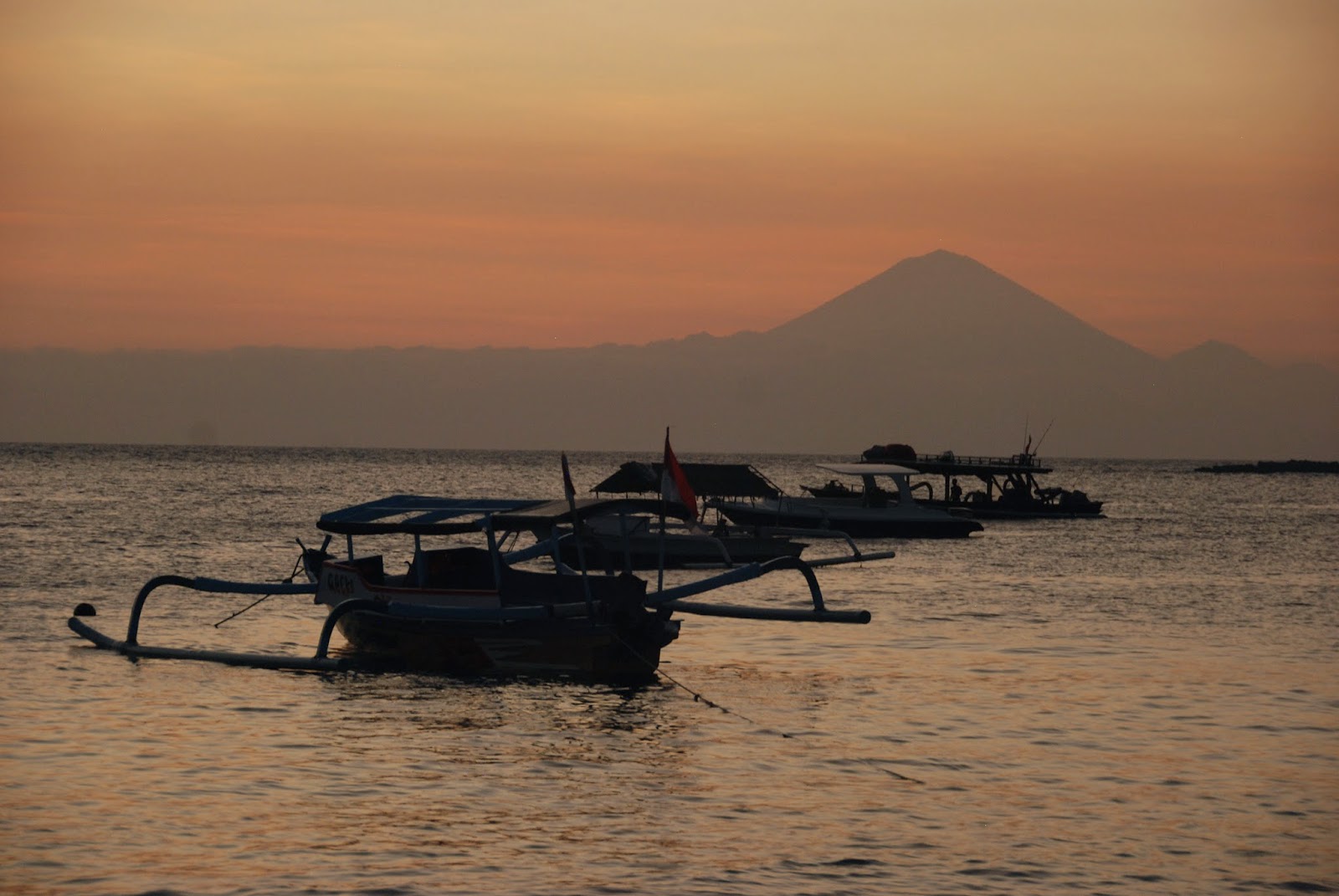
In the background we could see the silhouette of the Balinese volcano Gunung Agung.

Ryan and Christina on the Senggigi town beach.
Other than spending time on the beach, we walked around and had a massage. Nothing much to do in Senggigi, but we had a very nice hotel with a very nice pool.
Now alone again, we went with shuttle bus to the little town of Kuta Lombok on the south side of Lombok.
Laying on the beach and drank fruit juice and beer all day. In the evening we went out to eat on one of the many restaurants and
after that we went for good cheap drinks on one of the many bars.
Not a bad way of spending the days.
The beach were a bit disappointing because it was not as sandy as we hoped for, but had a lot of different size corals we needed to walk on to get in the water. That hurt, but the water was lovely. Warm and clear.
One of the days at Gili Travangan we decided to rent a private boat for the 5 of us and go for a 5 hour snorkeling trip.
That became an adventure.
Carina got really seasick. Ryan had taken a seasick tablet to avoid seasickness, but instead were so drowsy that he slept most of the trip. Anna were seasick, but not as bad as Carina, while Christina just felt bad.
But Markus felt good all the way.
Markus wearing the GoPro. He was one taking pictures all the day.
Carina before she got seasick.
The first stop, we were all in the water and snorkeled around. It was pretty with all the fish, but there were not much living coral reef.
At the second stop, Christina was the first to jump in the water and the first to dislike all the small stingers in the water. They stung us. After being in the water for a very short time we went back to the boat. We saw a turtle, but it was really far away and I guess the guide was the only one excited about that.
At the third stop, Markus was the only one snorkeling.
Markus snorkeling
We were close to the beach and the water was beautiful clear.
The girls went to the beach to use the bathrooms and Ryan was sleeping/relaxing in the boat.
Now it was time for lunch, which we had on the island Gili Air.
We also walked a bit around on the island.
It was very pleasant.
Bikes are used on the island. Many off them have wide tires.
A nice looking restaurant and Ryan posing behind the face.
Now in the boat again, we all felt good.
In the front Christina and Anna, in the back Carina and Ryan.
We only had about half an hour before reaching our Gili Travangan.
Carina together with Ryan
The tour back started really nice and the sea was calm and flat.
But the it became very rough and on the way back we all got so wet by the big waves splashing into our boat.
We were soaking wet when we reached our island, but we were happy.
Carina, Ryan and Markus want to eat and after we all lay on the beach and relaxed until evening, where we all went out.
It was a very interesting snorkeling trip.
All 5 of us wanted to go to Lombok, where Christina, Ryan and Anna were flying to Jakarta and Carina and Markus were going overland to Flores to see the Komodo dragons.
We went with a local ferry the 20 minutes to Bangsal on Lombok. From there we had rented a private taxi to take us to Sengigi, where we would stay together 1 night before Christina, Ryan and Anna were flying to Java and Jakarta. Markus and Carina stayed for one more night.
Lombok is similar to Bali, but without the same amount of tourists. There are more Muslims and mosques, but less temples. But most important the local people are just as friendly and smiling as in Bali. The island had a population of 3,2 million people in 2010 and is 4725 km2 big.
The indigenous Sasak people are all Muslims, but a minority Balinese Hindu culture remains on Lombok.
Our first overnight stop on the mainland of Lombok was Senggigi. Senggigi is the biggest tourist destination on Lombok, which does not mean a lot of tourists. The area is known for its beautiful west facing beaches.
Christina, Anna and Ryan taking pictures of and enjoying the sunset.
In Senggigi the sunset is amazing.
The locals were also on the beach and the kids were playing in the water.
Specially from the town beach it is spectacular.
In the background we could see the silhouette of the Balinese volcano Gunung Agung.
Ryan and Christina on the Senggigi town beach.
Other than spending time on the beach, we walked around and had a massage. Nothing much to do in Senggigi, but we had a very nice hotel with a very nice pool.
Now alone again, we went with shuttle bus to the little town of Kuta Lombok on the south side of Lombok.
We had a short stop in the provincial capital and largest city on the island, Mataram to change car and driver.Then we drove to the south coastal town of Lombok, Kuta.

Kuta has 2 streets, this is one of them.
Most Kuta retains its sleepy character as a little fishing village, where the indigenous live more or less undisturbed from tourists.

On the street we could buy fresh chili and

other spices and vegetables, but not a lot of fruits...

Dried fish were also sold on the street.

Markus at our favorite restaurant.

The view from the restaurant.

In Kuta there were many animals.

cows and

goats were everywhere.
In Kuta we rented a scooter and drove around.

Not to anywhere specific,

but to the beaches and villages around.


While we drove around we saw many tobacco fields among all the palm trees.

Other than our scooter drive around the region, we just relaxed on the beaches,

took it easy and used the internet.

The sand on the beaches here were also a bit rough, due to the coral sand.

We found a beach,

with a nice restaurant.

Here we sat and enjoyed the view and peacefulness, before we headed back to Kuta.

After staying a couple of nights we went overland to the island of Flores, better known as the place from where it is possible to take a tour to see the Komodo dragons.
The tour took us more than 27 hours and we decided to take a flight back. :)


