14. Malaysia @ Borneo - Bako National Park

Bako National Park opened as a protected area in 1957 and


is Sarawaks oldest, but one of the smallest national park in the region.


Bako National Park is situated north from Kuching on the tip of a jagged peninsula. It is special because it has beaches,


cliffs and


rainforest.


The walking trails are very hard, but luckily it is not a must to walk very long to see the different attractions in the park. An overnight visit to the park shoved us a lot of different types of animals plus different types of landscape. We walked a little and went for a boat ride.

We saw wild boars, long tailed macaques, proboscis monkeys and three different types of snakes.

To get to Bako National Park we first had to take a local bus almost an hour. After the bus ride we took a boat from a tiny fishing village.


The little fishing village "Kampung Bako" had only the jetty and some small houses.

After about 20 minutes in the little boat we arrived to a jetty from where we walked about 10 minutes to our very basic lodge.


The pathway from the jetty to the lodge, but also the way to where the rain forest treks begins.

The long tailed macaques are probably the most fearless monkeys in the world.


They steal everything they can get hold on.


And they really like soft drinks altough they still have some learning on how to use the can...


They are the same monkeys as we saw in Bali in the monkey forest.


But sometimes they are just cute and


look so innocent.

Bako National Park is home to approximately 275 proboscis monkeys found only on Borneo.


The male is an odd-looking creature with a huge pendulous nose and a large pot-belly. The average male weight about 20 kg.


The monkeys are mostly arboreal, moving about the forest or mangroves in small groups and feeding on young leaves, shoots, sour fruits and seeds.


Markus saw the first monkeys on a trail where he went alone, but the monkeys also came to the part of the rain forest where our lodge was.


We both saw them early in the morning while we were having breakfast and before all the day tours arrived in small boats and scared everything away from the forest around the lodge.


The Bornean bearded pig is Bako's largest mammal.
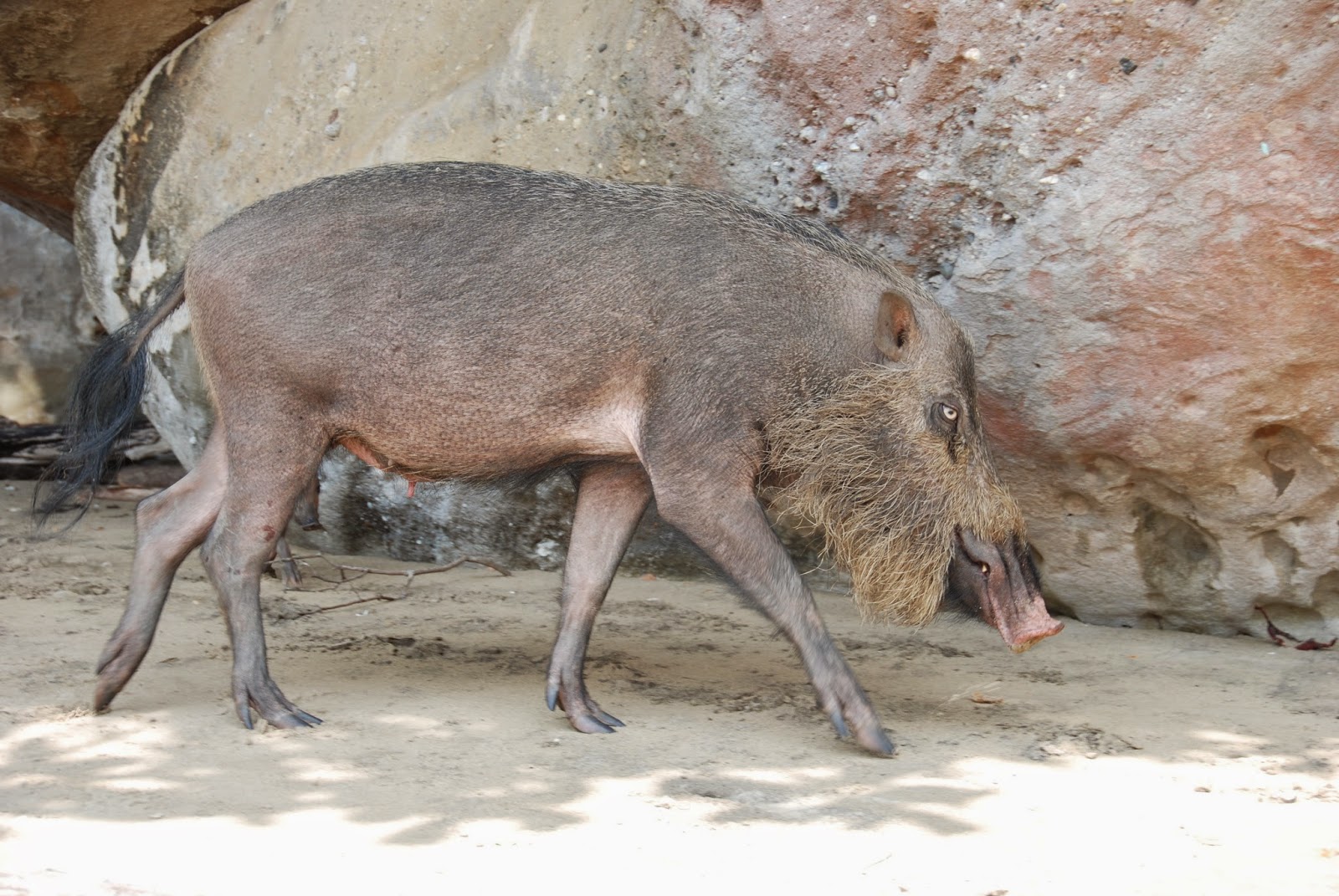

It is distinguished from other wild pigs by prominent bristles on either side of its snout.


Markus saw these boars on the trails, but they were also around our camp. We saw many of them and some of the had small piglets. They were really ugly, but cute in the same time. :)

We saw many brownish/greyish skinks or sun lizards scurrying away from the paths. These small fat lizards are many places around in the different parks and reserves in Borneo.

Bako National park is home to a number of snakes, most of which are harmless. They are well carmouflaged, and often slide off into the undergrowth at the first sign of danger or distubance.

We saw some snakes.

We saw the grass green viper snake. It has pencil thin body and has a long snout.


The only poisonous snake we saw is the Wagler's pit viper.


We recognized it by its broad, flat triangular head. This snake was green and not more than 30 cm. The only reason we found it was that a guide for tour group showed it to us. It was in our camp and we were told that it was totally drained for energy and just sat there and waited for some kind of little "food" to come by and then it would strike.

It was only Carina who saw the third snake. It was in the forest, but snaked away as soon as it felt me. It was red and black, thin and long, but we have no idea what kind of snake it was.

In the evening we went on a short walk. But it took us more than an hour to climb the less than two km.


We walked to a viewpoint and when we were finally up there we were rewarded with a great view over out camp.

On our boat ride


we really saw some amazing cliff formations.


Millions of years of erosion of the sandstone have created a coastline of steep cliffs, rocky headlands and stretches of white sandy bays.


Wave erosion at the base of the cliffs has carved many of the rocky headlands into fantastically shaped sea arches and seastacks with colored pattern formed by iron deposition.
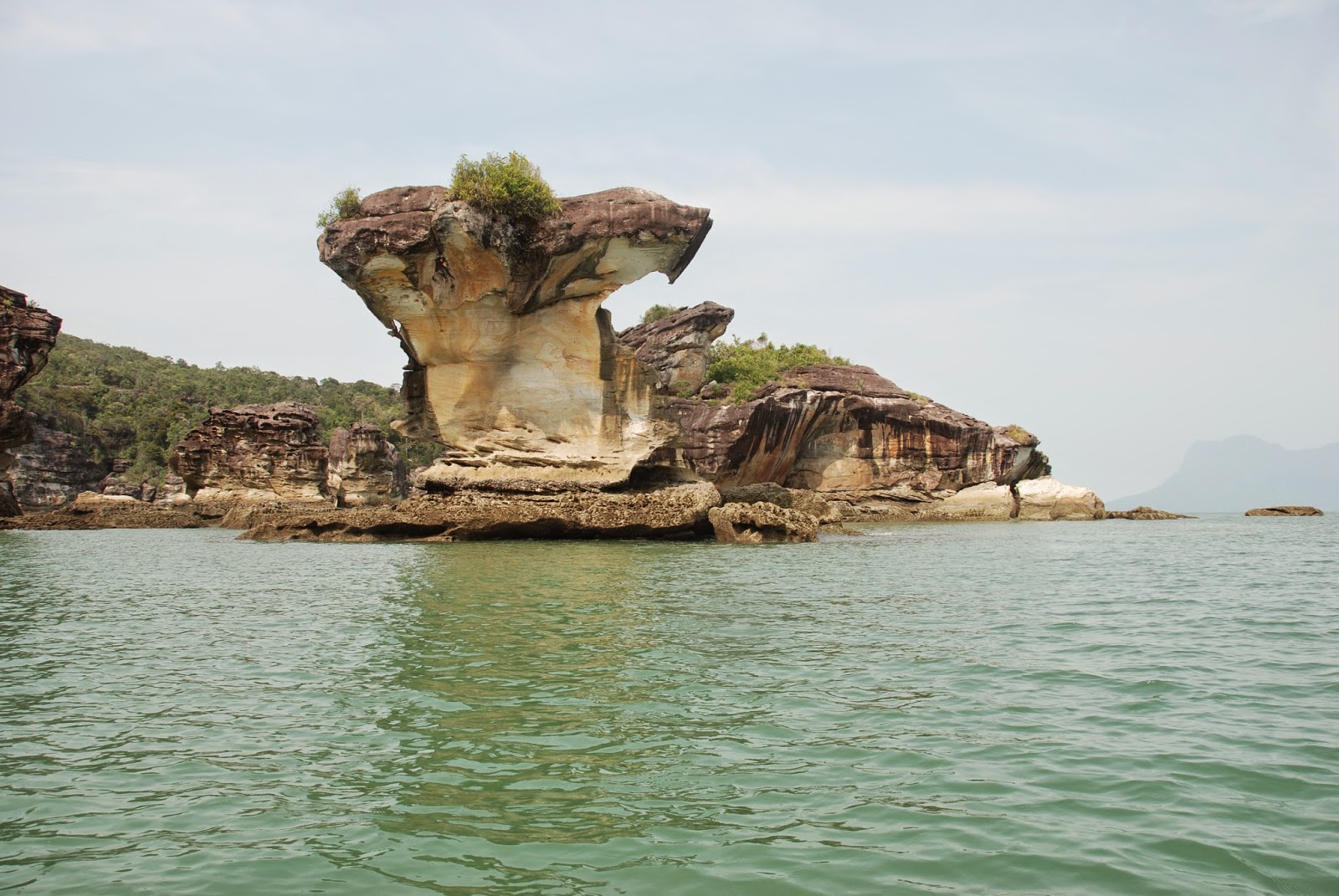

Bako National Park is famous for this (below) rock formation.


Also on the beach in front of the park HQ there was some nice rock formations.

And an example of a boat that we traveled with.

After two days and one night in Bako we went back to Kuching where we had booked a room from the Grand Supreme that we liked a lot.

13. Malaysia @ Borneo - Semenggoh + Matang


Now really exited we went to the Semenggoh Nature Reserve to see semi wild orangutans. The Semenggoh Wildlife Center was established in 1975 to care for wild animals which have either been found injured in the forest, orphaned or were previously kept as illegal pets. 

The orangutan is found in the rain forests of Malaysian Borneo, Indonesian Borneo and North Sumatra. And that is the reason for us to go to Borneo. We want to see the orangutans in the wild.

When we bought our tickets to enter the Nature Reserve we were told that it was not certain we would see orangutans due to fruiting season. 
Fruiting season is the season of the year, where there are most food to find for the orangutans in the forest. And because of that the monkeys don't need to come to the Wildlife Center and eat the food they there can get every day at the same time. 

This eating time would be the time where tourists can see them.

Orangutans are primarily fruit eaters and spend most of the day roaming the forest foraging for food. They are particularly fond of wild figs and the pungent smelling durian. Although fruit is their most important source of food they also feed on young leaves, insects, bark, flowers, eggs and small lizards.


And then we waited for the orangutans.


they never came...


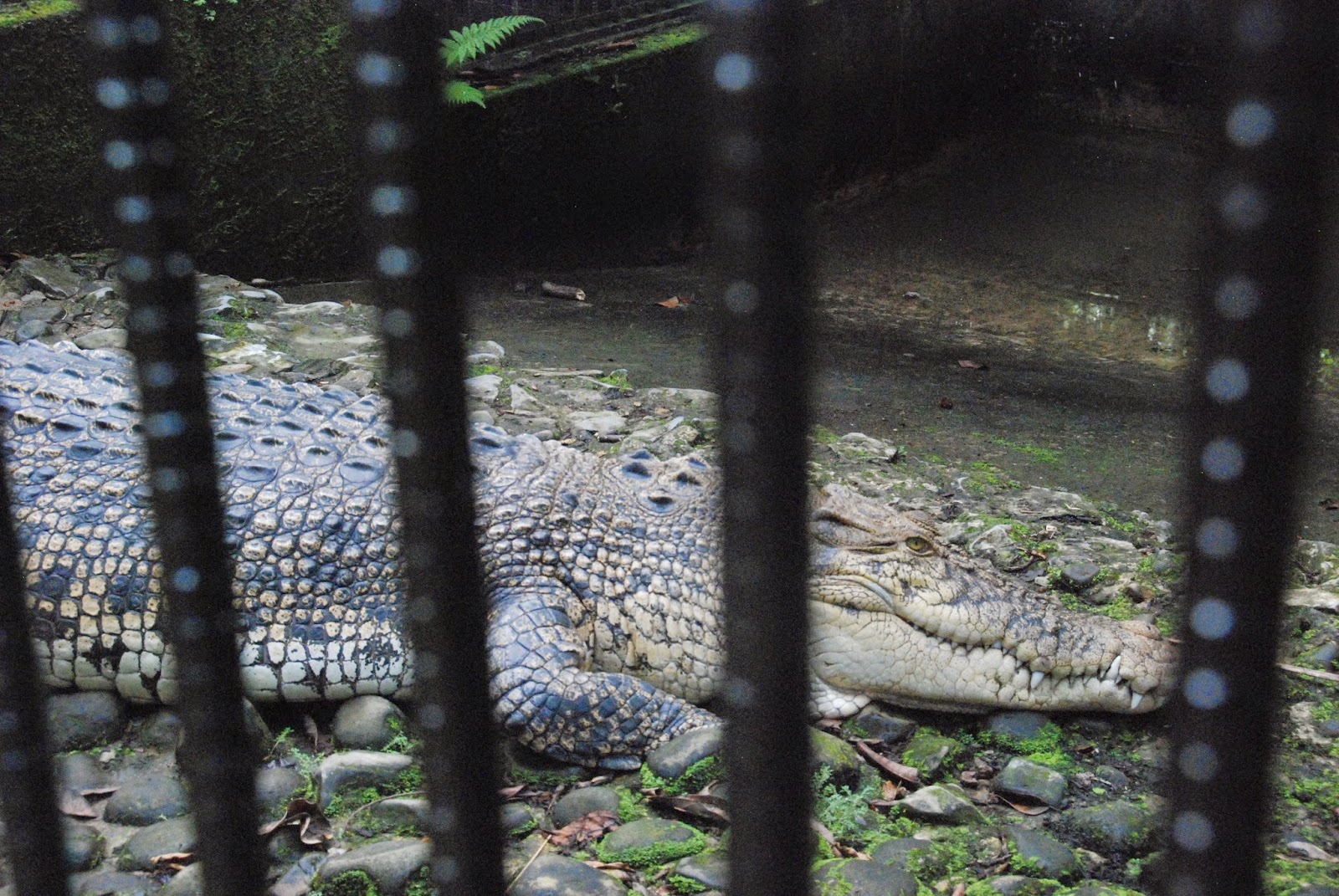
Instead we saw this huge crocodile in a very little cage (sad) and a movie about the orangutans.


Because we did not see orangutans in Semenggoh Nature Reserve we went to Matang Wildlife Center.

Here the monkeys are in large cages and not in the rain forests.

The place is a rehabilitation center and this is the rehabilitation program of a new rescue:

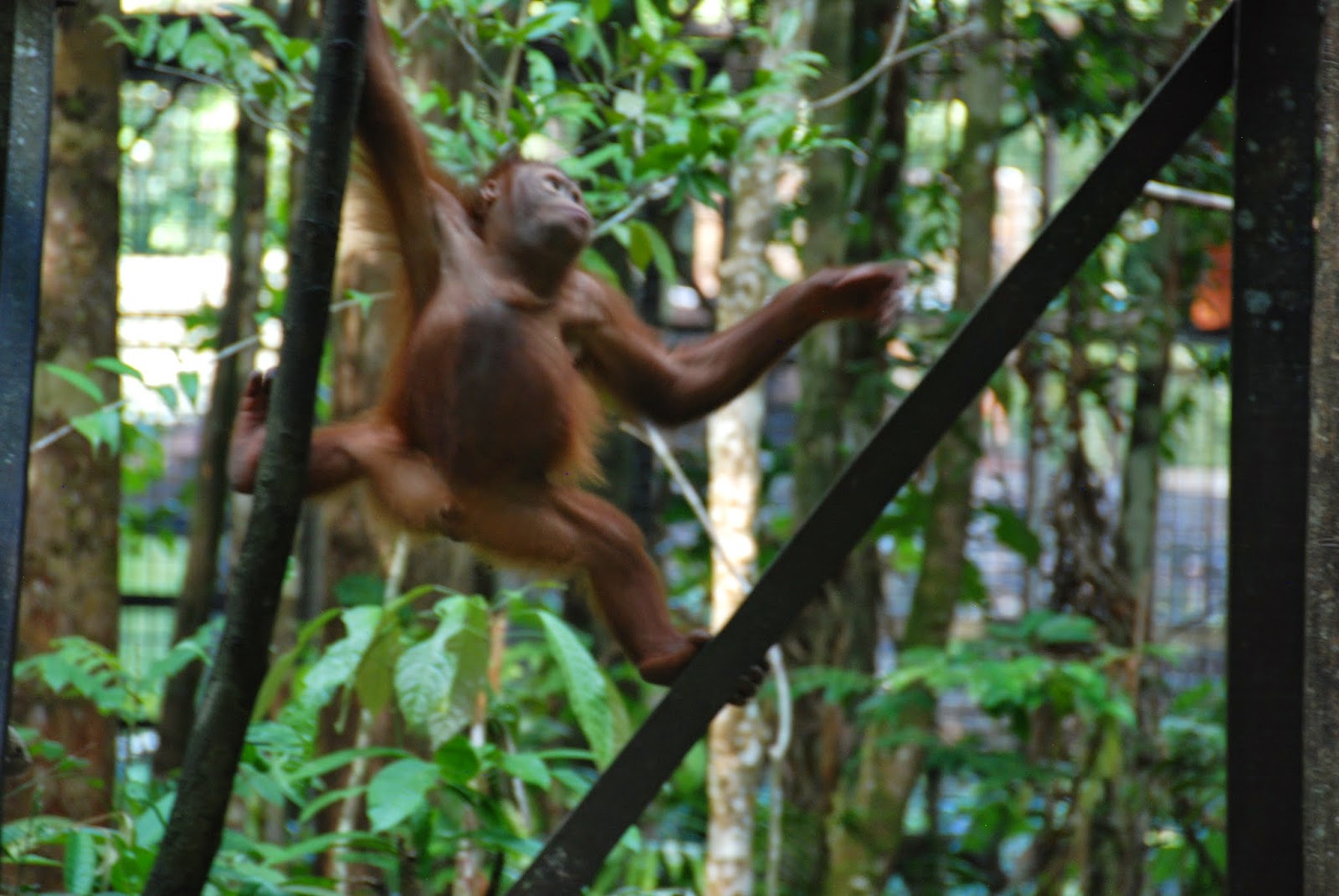
When a rescued orangutan arrives at the Center, it is given a medical check-up and placed in a cage. The first stage of the rehabilitation process then begins. Like young humans the young orangutan have to learn how to survive in their habitat. Everyday the wardens take them to suitable places in the forest where they learn how to climb trees, swing on branches and forage for food. After two to four years they are able to fend for themselves and the goal is to release them in to the wild.


It is one of the world's largest primates, and is almost completely arboreal (tree living).


A mature male has large check pads and a pendulous throat sac.


Adult males can reach a height of 150 cm, weight up to 100 kg and have an armspan of 240 cm. Females are about three quarters of the height and half the weight of the males.


The word "orang" is Malay for "person" whilst "utan" is derived from "hutan" meaning forest. So orangutan literally translate to "person of the forest".


Orangutans have a low reproductive rate where females usually give birth to a single infant once every 7-8 years.


Females reach sexual maturity at 12 years of age, but generally don't have their offspring until two or three years later. 


Males reach sexual maturity at 15 years, but their cheek pads may not fully develop until a few years later.


The life expectancy of orangutan in the wild is unknown, but is thought to be less than in captivity, where some have lived to over 50 years of age.


This baby we were told is only 1 year old.


We also saw a gibbon.


It looks really cute, but it doesn't always like tourists. It threw food after Markus. He was lucky. They told us that the monkey sometimes threw shit after tourists.


They had some hornbills.


All the animals at the center were rescued animals.


And a leopard.

We got a bonus. We spotted some big squirrels in the wild outside of the cages.

We will get back to the orangutan spotting again later on our journey. It is Carinas birthday present to see them in the wild.

12. Malaysia @ Borneo - Kuching

Then we arrived Kuching on Borneo, but first we flew from Yogyakarta on Java to Johor on mainland Malaysia and then ....


from Johor on mainland Malaysia to Kuching on Malaysian side of Borneo.


Borneo is the third largest island in the world. The island is divided by three countries. Malaysia and Brunei in the north covers 26 % and 1%. Indonesia to the south covers approximately 73 %. 

Borneo's population consists mostly of Malays, Chinese and Iban.

The Malaysian part is devided in two. Sarawak to the west and Sabah to the east. Sarawak meaning "The land of Hornbils" is the biggest of the two regions.

Natural resources, specially the industry of petroleum and palm oil, work with timber and tourism are the largest industries of Malaysian Borneo. 

We came to Borneo in rain, but


we checked in to our "Grand Suprime" hotel. It looked like something from the Eastern part of Europe. But it had lifts and our room was really really good. We had a good strong shower with hot water. The room was clean and we had a nice view from our window. Last we had a water boiler so we could make coffee and tea and boil noodles for dinner. Good and cheap.


Most hotels have these signs on the front doors. Durian is a fruit that is very typically here in Asia. It is very smelly and that is the reason for the hotels not to want it inside.


This view  together with the next couple of pictures is taken from our hotel room in Kuching.


Kuching is the capital and the most populous city in the state of Sarawak in Malaysia. The city is situated on the Sarawak River and has a population of about 350.000 people.


Kuching has a tropical rainforest climate, which means that the temperature is moderately hot and it is very humid, with the heat index often reaching 42 degrees. Kuching is also the wettest populated area in Malaysia with an average of 247 rainy days per year.


This picture we took an evening we walked around in Kuching. Its just a random building, Markus who took the picture just thought it was a nice building.

Kuching means cat in Malay and there were many cats in the city. Some alive and some as statues around the city.


These cats were just outside one of the two city halls in Kuching.


These cats were in the middle of a big roundabout in the middle of the city.


Here is a white cat just in front of the Chinese entrance to the Chinese street/part of the city.


There is a cat museum in Kuching and we went to visit it.


The cat museum was voted to be housed here in the northern city hall in year 1993. And believe it or not but it had quite many visitors. Some locals and some tourists like us.


We read in the museum that most people from Malaysia thinks that cats bring good luck and it is very important to have cats around.


The cat museum features more than 2000 feline related items.


It is more than just a museum. The place is also a research center, that focuses on the history and various beliefs surrounding cats.


Among the most impressive displays are a mummified Egyptian cat dating back to 3500 BC. But we were not aloud to take pictures of it.


They also had a little Garfield collection.


We read that it is believed that the cat museum is the only one of its kind in the world and that it is a must visit attraction for cat lovers. So of course we visited it. :)


The view from the city hall was really nice and the best thing was that we got a ride from a nice British gentleman back to the city center.


Kuching Mosque with the big gilded cupolas is the largest religious building in Sarawak.

Kuching plays an important role in the political and economic welfare of the population of Sarawak.


This is the Sarawak State Legislative Assembly, completed in year 2009. It is the meeting place where state assemblymen from all over Sarawak will meet and preside over debates and passing laws.


The orchid garden in Kuching has a collection of 75000 orchids, growing in open and shaded areas resembling their natural habitats.


It was serious warm that day and we both got a little sunburned even that we used sunscreen. :( But the orchids were beautiful.


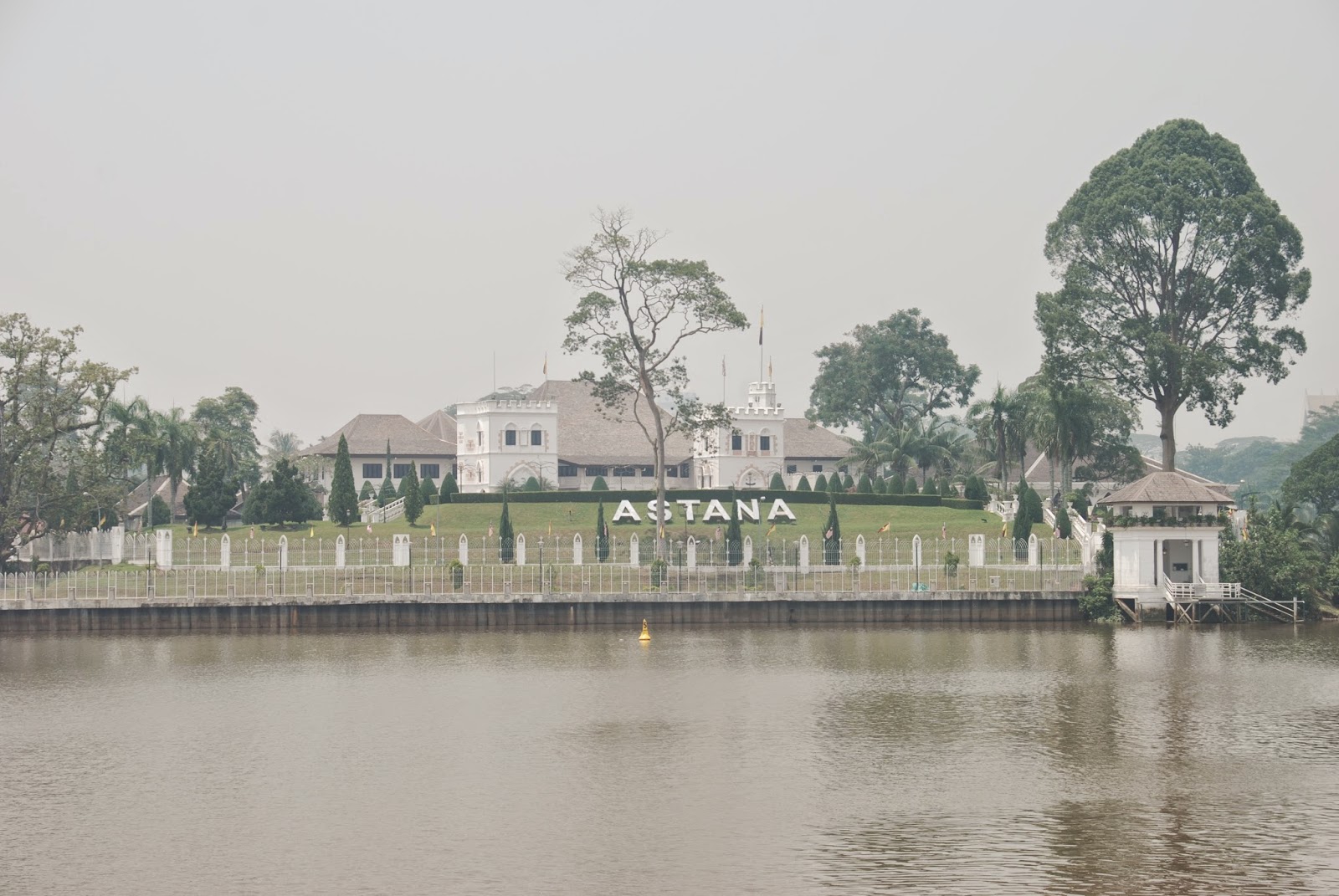
This is the Astana, built in year 1870, which is the official residence of the Yang di-Pertua Negeri (Governor) of Sarawak


This is Markus and fort Margherita built in year 1879 by Charles Brooke. The fort is named after his wife.


The State Legislative Assembly together with the orchid garden, the Istana and the fort Magherita were on one side of the river, while most of Kuching city including our hotel was on the other side.


This is a picture of one of the water-taxis that will take you across the river whenever you need to cross.